
BigMile | Logistics Sustainability and Efficiency
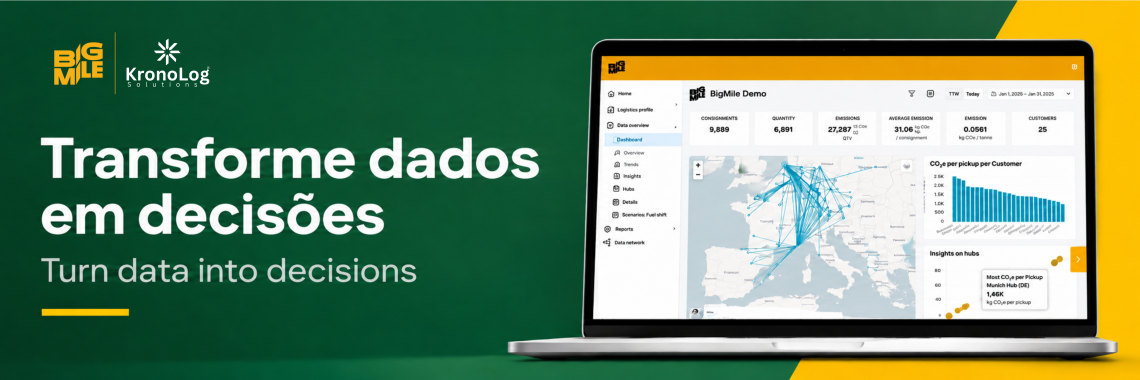
Measure emissions. Improve efficiency.
BigMile enables businesses to calculate, analyse and report CO₂ e emissions from their logistics operations. With support from KronoLog Solutions in Portugal, turn environmental data into tangible opportunities for operational efficiency and decarbonisation.
You cannot improve what you cannot measure
Sustainability is no longer just an environmental concern. It is increasingly a driver of competitiveness, operational efficiency and commercial differentiation.
Businesses face growing pressure to understand and communicate the emissions associated with their logistics operations, driven by customer requirements, reporting obligations and sustainability commitments.
However, many organisations still rely on fragmented data, generic estimates and manual processes that make it difficult to gain an accurate understanding of the environmental impact of transport.
- Lack of visibility: Without structured information, it is difficult to identify which routes, customers, operations or transport modes contribute most to emissions.
- Fragmented data and manual reporting: Information is often spread across different systems, carriers and partners, making emissions calculations and reporting time-consuming.
- Difficulty turning data into improvements: Knowing total emissions is not enough. The real value lies in understanding what drives them and identifying decisions that can improve efficiency and reduce environmental impact.
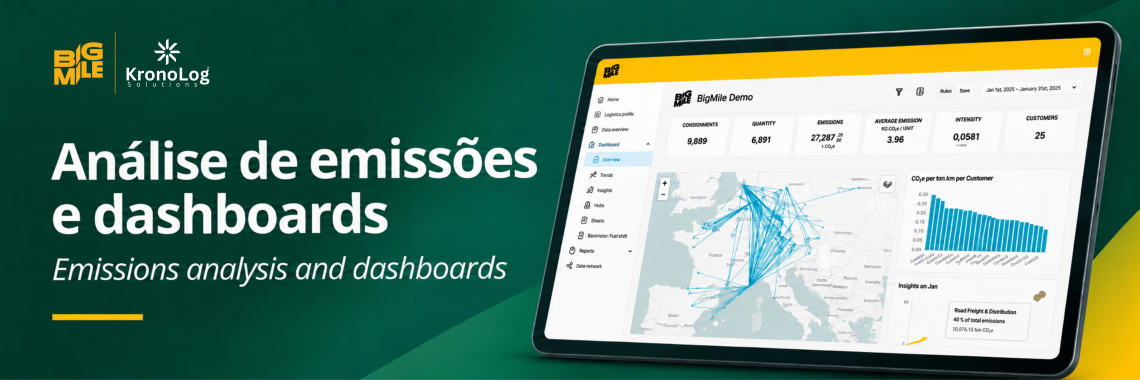
BigMile is a technology platform specialising in the calculation, analysis and reporting of greenhouse gas emissions associated with transport and logistics operations.
By integrating operational data, it enables companies to measure their carbon footprint, understand the sources of emissions and identify concrete opportunities for improvement.
More than simply presenting environmental indicators, BigMile transforms data into useful information for decision-making, helping organisations reconcile sustainability, operational efficiency and competitiveness.
Using a methodology aligned with the ISO 14083 standard, the platform supports the consistent calculation and communication of emissions throughout the supply chain.
From operational data to better decisions.
BigMile transforms information from transport and logistics operations into reliable environmental indicators through a structured process of data collection, calculation, analysis and reporting.
- Data collection and integration: The platform uses operational information such as origins and destinations, distances travelled, transport modes, vehicle characteristics, fuel consumption and transported volumes. Data can be imported from files or integrated with management systems, reducing the need for manual processing.
- Data validation and processing: BigMile analyses the quality and consistency of the data received, helping to identify incomplete information and progressively improve the reliability of calculations.
- Emissions calculation: Based on the available data and recognised methodologies, the platform calculates greenhouse gas emissions associated with transport and logistics activities.
- Analysis and visualisation of results: Results are presented through dashboards and indicators that help users understand the distribution of emissions across different operational dimensions, such as customers, routes and transport modes.
- Reporting and continuous improvement: The information can be used to support environmental reporting, monitor emissions trends and identify opportunities for improvement and decarbonisation.
The result? A clearer picture of the environmental impact of operations and a consistent information base for making more efficient and sustainable decisions.
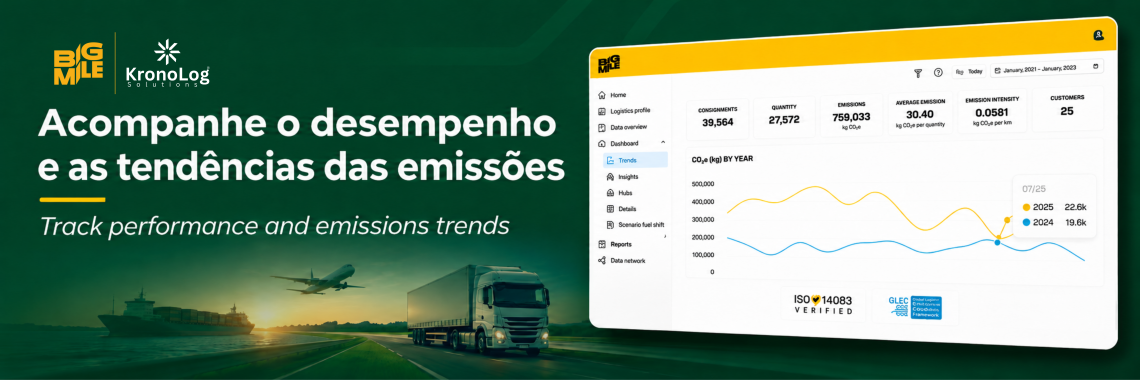
Understand the environmental impact of your operations and discover where you can improve.
BigMile Carbon Analytics enables companies to analyse and monitor CO₂e emissions associated with transport and logistics operations, transforming operational data into clear, actionable indicators.
Through interactive dashboards, companies can understand how their emissions evolve over time, compare results and identify the activities with the greatest environmental impact.
With Carbon Analytics, you can:
- Monitor CO₂e emissions, tracking their evolution over time.
- Analyse different operational dimensions, such as routes, customers, carriers and transport modes.
- Identify trends and deviations, recognising opportunities for improvement.
- Compare performance indicators, supporting the assessment of the environmental efficiency of operations.
- Make data-driven decisions, setting priorities to reduce emissions and improve resource utilisation.
More than measuring emissions, what matters is understanding what causes them and how we can reduce them.
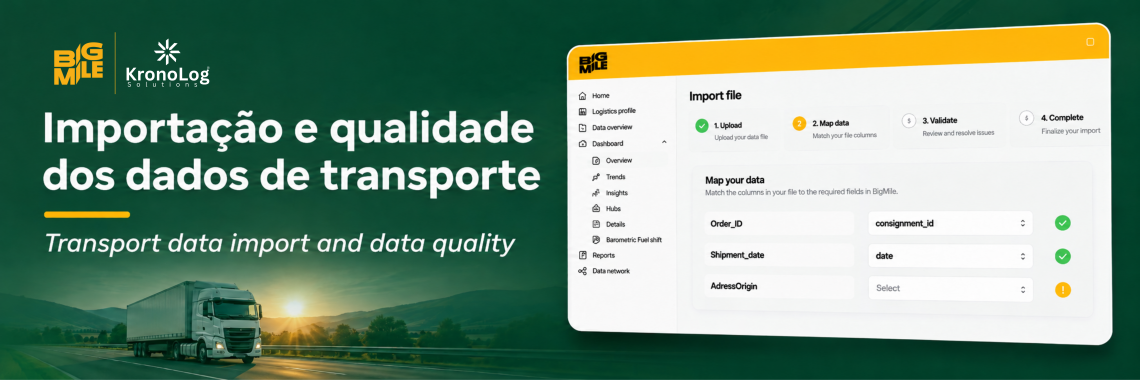
The quality of results starts with the quality of the information used.
To calculate CO₂e emissions accurately, collecting data is not enough. It is essential to ensure that operational information is consistent, complete and suitable for the calculation methodologies used.
BigMile facilitates the import and processing of transport data, helping companies identify gaps, correct inconsistencies and progressively improve the reliability of the information used.
How BigMile helps improve data quality:
- Structured data import: enables operational information from different sources and systems to be uploaded.
- Field mapping: facilitates the matching of imported data to the fields required for emissions calculations.
- Identification of inconsistencies: helps detect incomplete or incorrect information before processing.
- Greater calculation consistency: contributes to more comparable and well-founded results.
- Continuous data quality improvement: helps identify areas for improvement in data collection and management processes.
Better-quality data enables more reliable calculations, more accurate analyses and better-informed decisions.
By improving the quality of operational information, companies build a stronger foundation for monitoring their environmental performance and identifying opportunities for efficiency and decarbonisation.
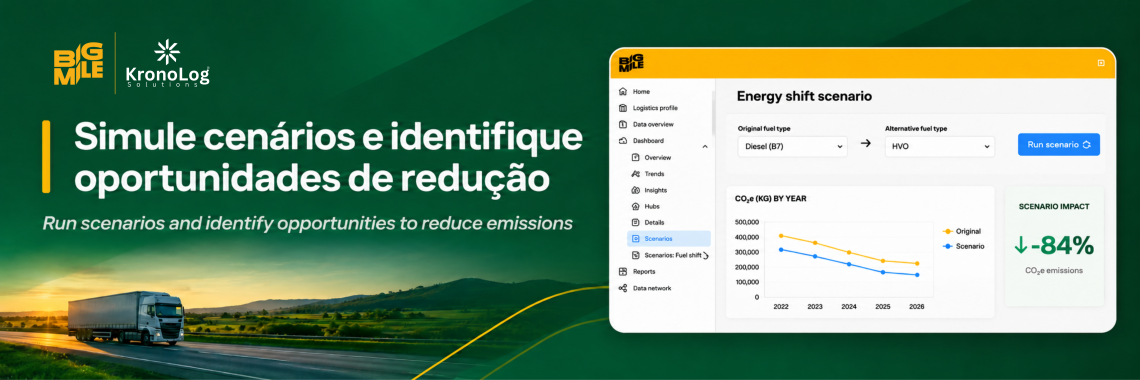
Before investing in a change, it is important to understand its potential impact
Reducing emissions associated with transport requires informed decisions. Choosing alternative fuels, changing transport modes or reviewing certain operations can create opportunities for decarbonisation, but it is essential to assess their impact before moving forward.
BigMile provides simulation capabilities that allow companies to analyse alternative scenarios and estimate the potential impact of specific measures on reducing CO₂e emissions.
Through scenario analysis, companies can:
- Simulate the use of alternative fuels, comparing their estimated impact on emissions.
- Evaluate different decarbonisation options, based on the data and functionalities available on the platform.
- Compare current and alternative scenarios, identifying the potential for emissions reduction.
- Support investment and operational transformation decisions, using environmental indicators.
- Monitor the progress of their decarbonisation strategy, linking objectives, measures and results.
The goal is not just to know how much we emit today, but to understand what we can do to emit less tomorrow.
It is this transition from measurement to decision-making that turns sustainability into a concrete opportunity for operational improvement.
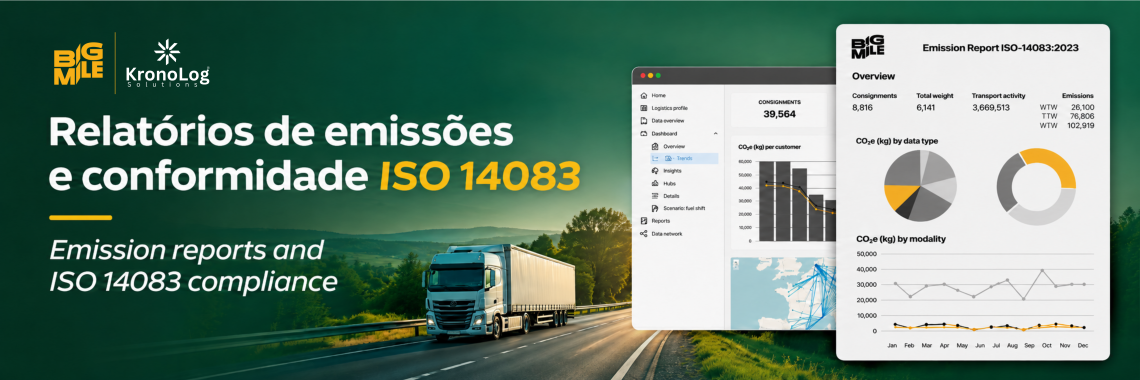
Turn your logistics operations data into consistent, transparent environmental information that meets market requirements.
Measuring greenhouse gas emissions associated with transport requires recognised methodologies, consistent calculation criteria and information that can be communicated with confidence.
BigMile supports companies in calculating and reporting CO₂e emissions using methodologies aligned with ISO 14083:2023, the international standard for quantifying and reporting greenhouse gas emissions from transport chain operations.
The platform enables companies to structure environmental information and produce reports that facilitate the communication of results to customers, partners and other stakeholders.
With BigMile's reporting capabilities, companies can:
- Calculate and report CO₂e emissions, based on internationally recognised methodologies.
- Apply the principles of ISO 14083, promoting consistency and comparability of results.
- Present detailed information, enabling emissions analysis across different dimensions of transport operations.
- Support sustainability commitments, providing information for environmental reports and customer requests.
- Monitor emissions trends, facilitating the assessment of the results of implemented measures.
The credibility of environmental information depends on rigorous calculations and transparent methodologies.
With BigMile, emissions reporting goes beyond a communication requirement and becomes a tool for supporting management decisions, identifying efficiency opportunities and driving continuous improvement.
Environmental information should be part of management processes, without creating additional administrative work.
Transport and logistics companies use different systems every day to manage orders, shipments, routes, customers and operations. Integrating emissions calculations into these processes makes it possible to obtain environmental information more efficiently and consistently.
The BigMile Emissions API enables CO₂e emissions calculation capabilities to be integrated into business applications and systems, such as TMS, ERP and other logistics management platforms, through programming interfaces.
What are the main benefits of this integration?
- Automated emissions calculations: enables CO₂e calculations to be incorporated into existing processes and applications.
- Less manual work: reduces the need to repeatedly transfer and process information between different systems.
- Integration with operational processes: facilitates the use of transport data already available in the company's systems.
- More accessible environmental information: makes emissions results available within the applications and processes where they are needed.
- Greater integration capabilities: supports the development of digital solutions that incorporate environmental indicators into logistics operations.
Sustainability should not operate as a process isolated from day-to-day operations. It should be integrated into how a company works and makes decisions.
With the BigMile Emissions API, organisations can bring environmental management closer to operational management, reducing administrative tasks and making emissions data easier to use in everyday activities.
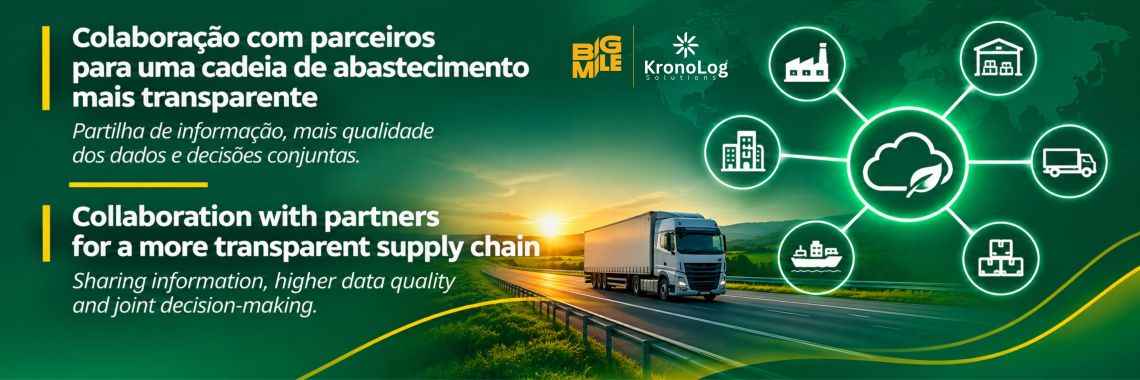
Sustainability in logistics is a shared challenge. The best results depend on collaboration between all stakeholders.
In a supply chain, the information needed to calculate emissions is often spread across different organisations. Shippers, carriers, logistics service providers and other partners hold data that, when shared in a structured way, can provide a more complete picture of the environmental impact of operations.
BigMile provides collaboration and information-sharing capabilities that help companies work with their partners to measure and communicate CO₂e emissions.
What are the benefits of a collaborative approach?
- Greater transparency: facilitates the exchange of environmental information between different stakeholders across the supply chain.
- Better data quality: enables estimates to be supplemented with operational information provided by partners.
- Consistent communication: promotes the use of comparable methodologies and indicators.
- Support for customer commitments: makes it easier to respond to requests for emissions information related to transport and logistics services.
- Identification of joint opportunities: creates opportunities to evaluate efficiency and decarbonisation measures in collaboration with partners.
Reducing emissions depends not only on the decisions made by individual companies, but also on their ability to work together across the supply chain.
With BigMile, environmental information can become a valuable tool for collaboration between companies, contributing to more transparent business relationships and better-informed decisions.
Measuring emissions is important. Turning that information into better decisions is what creates value.
BigMile helps companies integrate sustainability into the management of their logistics operations, providing information to understand environmental performance, identify improvement opportunities and respond to growing market demands.
More than an emissions calculation solution, it is a management support tool that connects environmental objectives with the operational and commercial needs of organisations.
- Greater operational visibility: Understand the emissions associated with your transport and logistics activities, identifying the main factors contributing to your operations' environmental impact.
- Data-driven decisions: Use environmental indicators to evaluate alternatives, set priorities and support operational improvement and decarbonisation decisions.
- Reduced administrative workload: Structure and automate calculation and reporting processes, reducing reliance on spreadsheets, manual data processing and repetitive tasks.
- Identification of efficiency opportunities: Analyse routes, transport modes and other operational dimensions to identify situations where greater efficiency can also contribute to lower emissions.
- Improved responsiveness to customers: Provide more consistent and structured environmental information, making it easier to respond to requests from customers, partners and other stakeholders.
- Support for your decarbonisation strategy: Establish a baseline, monitor emissions over time and assess the potential impact of measures aimed at reducing your operations' carbon footprint.
- Differentiation and competitiveness: Strengthen your company's ability to meet environmental requirements and demonstrate a structured approach to sustainability in business relationships.
The true value of BigMile lies in turning environmental information into a tool for management, efficiency and competitiveness.
With the support of KronoLog Solutions in Portugal, companies can explore these capabilities from a practical perspective, connecting the platform's insights with real opportunities to improve their logistics operations.
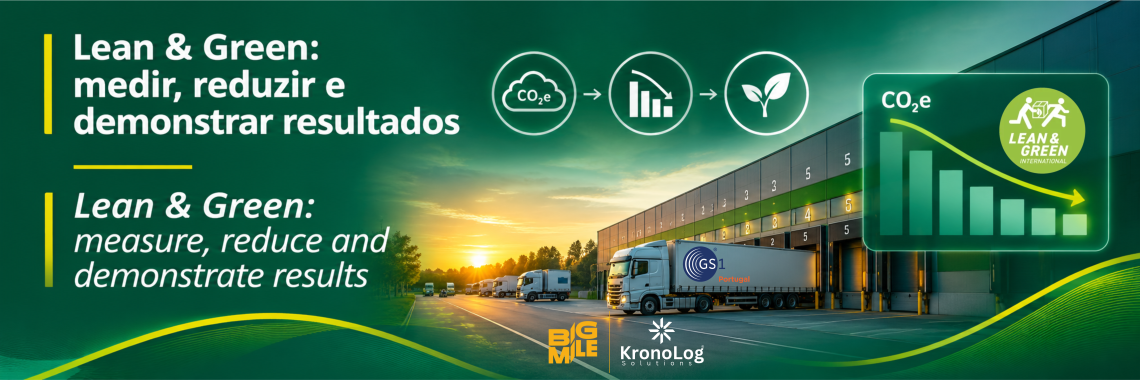
Decarbonising logistics requires more than commitments. It requires reliable data, clear objectives, and measurable results.
Lean & Green is an international program that encourages companies to reduce greenhouse gas emissions associated with their logistics activities, promoting a structured approach to decarbonization and continuous improvement.
In Portugal, the program is coordinated by GS1 Portugal, supporting organizations in defining emission reduction commitments and demonstrating the progress achieved.
BigMile is a partner of the Lean & Green program, providing emissions calculation and analysis technology that can help companies establish a baseline, identify improvement opportunities, and monitor the results of their decarbonization initiatives.
How can BigMile support this journey?
- Establish a baseline: quantify emissions from logistics operations and create a starting point for monitoring progress.
- Identify emission reduction opportunities: analyze the main emission drivers and evaluate improvement alternatives.
- Monitor performance indicators: track emissions over time and compare results.
- Support the communication of results: provide structured information to document progress.
- Promote continuous improvement: use data to support new decisions and strengthen the effectiveness of implemented measures.strar a evolução.
Measuring helps establish the starting point. Analyzing helps identify opportunities. Taking action and monitoring results makes it possible to demonstrate progress.
As BigMile's official representative in Portugal, KronoLog Solutions aims to strengthen collaboration with GS1 Portugal, helping to bring emissions measurement technology closer to the practical needs of companies participating in Lean & Green.
Our goal is to help organizations turn their environmental commitments into data-driven initiatives, simultaneously promoting logistics efficiency and emissions reduction.
Technology provides the data. Operational expertise turns that data into results.
KronoLog Solutions is BigMile's official representative in Portugal, giving Portuguese companies access to a platform specialised in calculating, analysing and reporting greenhouse gas emissions associated with transport and logistics.
As a consultancy specialising in logistics and supply chain efficiency, KronoLog Solutions aims to help organisations improve their operational performance through process analysis, technology adoption and data-driven decision-making.
The partnership with BigMile reinforces this commitment, making it possible to integrate environmental considerations into the assessment and improvement of operational efficiency.
How can we support your business?
- Needs assessment: understand your company's operational reality, sustainability objectives and emissions calculation and reporting requirements.
- Platform presentation and demonstration: identify the BigMile features most relevant to your organisation's needs.
- Implementation support: assist with operational data preparation and platform adoption, in coordination with the BigMile team.
- Integration with existing processes: identify opportunities to connect environmental information with existing logistics management systems and processes.
- Analysis and identification of improvements: support the interpretation of environmental indicators and the identification of efficiency and decarbonisation opportunities.
- Local support: provide a point of contact in Portugal, facilitating communication and ongoing assistance with customer needs.
Our goal is not simply to help companies understand their emissions. It is to help them understand what lies behind those figures and identify concrete opportunities for improvement.
By combining BigMile's technology with KronoLog Solutions' operational expertise, we aim to turn emissions measurement into a management tool that contributes to more efficient, competitive and sustainable operations.
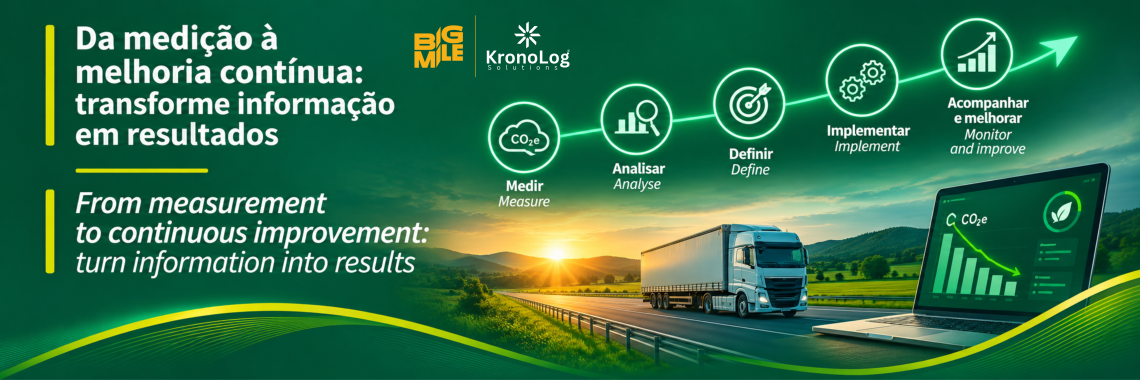
Measurement is the starting point. Continuous improvement is the real objective.
Reducing emissions associated with transport and logistics is not the result of a single decision. It requires an ongoing approach to analysis, planning, implementation and evaluation of results.
BigMile enables companies to monitor the environmental performance of their operations over time, providing information that helps them understand the impact of their decisions and identify new opportunities for improvement.
When this information is integrated into management processes, sustainability becomes more than a reporting exercise and starts contributing to more efficient operations.
A data-driven continuous improvement cycle:
- Measure: establish a baseline for CO₂e emissions associated with logistics operations.
- Analyse: identify the activities, routes, customers or transport modes with the greatest environmental impact.
- Plan: define priorities and evaluate efficiency and decarbonisation measures.
- Implement: put the identified improvements into practice, involving the relevant teams and partners.
- Monitor and improve: track performance indicators, assess the results of implemented measures and use this information to refine decisions and identify new optimisation opportunities.
Continuous improvement begins when we stop simply looking at indicators and start using them to transform operations.
At KronoLog Solutions, we believe that operational efficiency and sustainability should evolve together. Through our partnership with BigMile, we aim to help companies use reliable environmental information to make better decisions, reduce waste and develop more competitive and sustainable logistics operations.
Because the goal is not just to measure better. It is to operate better.
Find answers to the most common questions about the BigMile platform, emissions calculation, technology integrations and subscription conditions in Portugal.
1. The BigMile Platform
- What is BigMile? BigMile is a technology platform specialising in the calculation, analysis and reporting of greenhouse gas (CO₂e) emissions associated with transport and logistics. It transforms operational data into environmental indicators that support management, sustainability and continuous improvement.
- Who is BigMile designed for? BigMile is designed for carriers, logistics service providers, freight forwarders, manufacturers, distributors, retailers and other organisations seeking to understand and manage emissions across their supply chains. It is suitable for both domestic and international operations, with different plans and features depending on each company's needs.
- Do I need specialised sustainability knowledge to use the platform? No. BigMile has been developed for both experienced emissions professionals and operational or management teams starting their sustainability journey. The platform provides dashboards and reports that make results easier to interpret, and training is also available during implementation.
- How does BigMile differ from a conventional emissions calculator? A conventional calculator typically estimates emissions for a single journey or operation. BigMile can process large volumes of information, calculate emissions at shipment level, analyse trends, compare operations, generate reports and identify improvement opportunities over time.
- Can BigMile analyse different modes of transport? Yes. The platform supports road, rail, maritime, air and inland waterway transport. This enables the analysis of multimodal supply chains and the calculation of emissions associated with different transport legs.
2. Emissions Calculation, Data and Integrations
- Which emissions can be calculated using BigMile? BigMile calculates CO₂e emissions associated with transport and logistics activities. Depending on a company's operational structure and responsibility for transport activities, these emissions may fall under Scope 1, 2 or 3 of the GHG Protocol. Within Scope 3, categories 3.4, Upstream Transportation and Distribution, and 3.9, Downstream Transportation and Distribution, are particularly relevant.
- What data is required to calculate emissions? The required data depends on the operation and the desired level of detail. It may include origins and destinations, distances, dates, transport modes, vehicle characteristics, transported quantities and fuel consumption. The higher the quality and level of detail of the available information, the more accurate and useful the analysis can be.
- Can emissions be calculated when complete carrier data is unavailable? Yes. BigMile prioritises primary operational data, such as actual fuel consumption. When this information is unavailable, reference emission factors from the GLEC Framework and other operational data can be used to produce estimates. The platform allows calculation quality to improve progressively as more complete data becomes available.
- Can BigMile integrate with our company's TMS or ERP? Yes. BigMile provides integration solutions, including the Emissions API, which allow emissions calculation capabilities to be incorporated into TMS, ERP and other business applications. The API is integrated into more than 30 software platforms. Integration feasibility and the appropriate approach should be assessed according to the systems used by each company.
- What is considered a record in BigMile? A record corresponds to one transport leg within a shipment. For example, if a shipment involves road transport, followed by maritime transport and then another road leg, these three stages correspond to three records. This distinction is important when assessing data volumes and selecting the appropriate subscription plan.
3. Standards, Reporting and Sustainability
- Is BigMile aligned with ISO 14083:2023? Yes. BigMile's calculation methodology and system have been independently verified against the principles of ISO 14083:2023, the international standard for quantifying and reporting greenhouse gas emissions from transport chains. BigMile also holds Smart Freight Centre accreditation in relation to the GLEC Framework.
- Which emission factors does BigMile use? BigMile uses the GLEC Framework as its primary reference for emission factors across different transport modes. Where suitable primary data is available, such as actual fuel consumption, it can be used to improve calculation accuracy.
- Can BigMile generate emissions reports for customers? Yes. BigMile allows companies to generate customer-specific emissions reports and provide structured environmental information to support commercial requests, sustainability commitments and reporting requirements. When both organisations use the platform, shipment-level information-sharing features are also available.
- Can BigMile support Scope 3 emissions reporting and ESG requirements? Yes. BigMile can provide information on transport and distribution emissions relevant to Scope 3 emissions inventories and environmental reporting processes. However, using the platform does not, by itself, replace a comprehensive assessment of each organisation's applicable legal and reporting obligations.
- What is the relationship between BigMile and the Lean & Green programme? BigMile is a partner of the Lean & Green programme, an international initiative promoting emissions reductions in logistics activities. The platform can help companies quantify emissions, establish a baseline, assess reduction measures and monitor results. In Portugal, the Lean & Green programme is coordinated by GS1 Portugal.
4. Subscription, Implementation and Support
- What subscription plans does BigMile offer? BigMile offers different Carbon Analytics plans, including Basic, Premium and Enterprise, with features and capacities tailored to organisations' needs. Specific conditions also apply to the Emissions API and additional features, such as the subcontractor portal and API data exports. Plan selection depends on factors including record volumes, integration requirements, number of users and desired features.
- What is the minimum subscription period? According to BigMile's published terms, the minimum subscription period is 12 months. Specific commercial conditions should be confirmed in the proposal presented to each company.
- Can I try BigMile before subscribing? Yes. BigMile offers free trial options for certain plans. A 15-day trial period is advertised for new Emissions API customers. Availability and access conditions should be confirmed for the solution required.
- How is data security ensured? BigMile implements technical and organisational information protection measures and states compliance with the GDPR. The company provides documentation concerning security audits and controls, including SOC 2 Type II and ISAE 3000 Type II. Specific data processing, storage and sharing conditions should be assessed during the contracting process.
- Who provides implementation and user support for BigMile in Portugal? KronoLog Solutions is BigMile's official representative in Portugal, providing commercial contact and consultative support to Portuguese companies. We can assist with needs assessment, platform demonstrations, implementation preparation and identifying opportunities to use environmental indicators to improve logistics operations. Support is provided in coordination with the BigMile team, according to each project's needs and characteristics.
Discover how to turn your logistics data into more efficient and sustainable decisions.
KronoLog Solutions, BigMile's official representative in Portugal, helps you identify the solution best suited to your company's needs.
Explore the platform: See BigMile in action and discover how to measure, analyse and report emissions from your operations.
Have questions? Learn about available plans, integration options and implementation conditions..